When Does a Business Owner Get to Stop Working?
I have been thinking about a kind of business advice that sounds ambitious but can quietly become cruel: keep going, keep posting, keep responding, and never miss a chance to make money. It assumes that every unanswered message is a lost customer and every evening off is a missed opportunity. I believe businesses need profit and integrity in equal measure. If the first comes at the price of the owner's health, family time, honesty or ability to deliver, then the business may be growing in the wrong direction.
There is a practical question beneath that belief: when does a small business owner get to close the shop? It matters to a person running a barbershop, cleaning service or food business and to someone working a full-time job while testing a modest side venture. The answer should not be that customers must wait indefinitely, but neither should it be that the owner is available 24 hours a day. Good boundaries are part of good service.
A Boundary Can Be a Customer Promise
I understand the objection. A new business is often competing with larger companies that have late hours, automated support and teams across time zones. An early-stage entrepreneur may need flexibility. Someone facing overdue bills may not have the luxury of turning down a legitimate paying job. There are also emergencies in which prompt communication genuinely matters. Closing time should never become an excuse to abandon people after taking their money.
Still, a truthful boundary is better than the performance of constant availability. Customers can adapt to an honest operating schedule, a simple response-time expectation and a clearly defined booking process. They struggle when a business advertises instant support but provides inconsistent replies. A founder who says, 'I answer new inquiries the next business day,' may be making a stronger promise than a founder who says, 'I'm always here,' and cannot deliver on it.
This is why I connect profitability with morality. Profitability is what pays the costs and keeps the doors open. Morality shapes how we earn that revenue: understandable prices, an accessible offer, responsible customer communication, respect for time and a willingness to acknowledge limitations. Neither is a replacement for the other.
Codee's Four Practical Doors
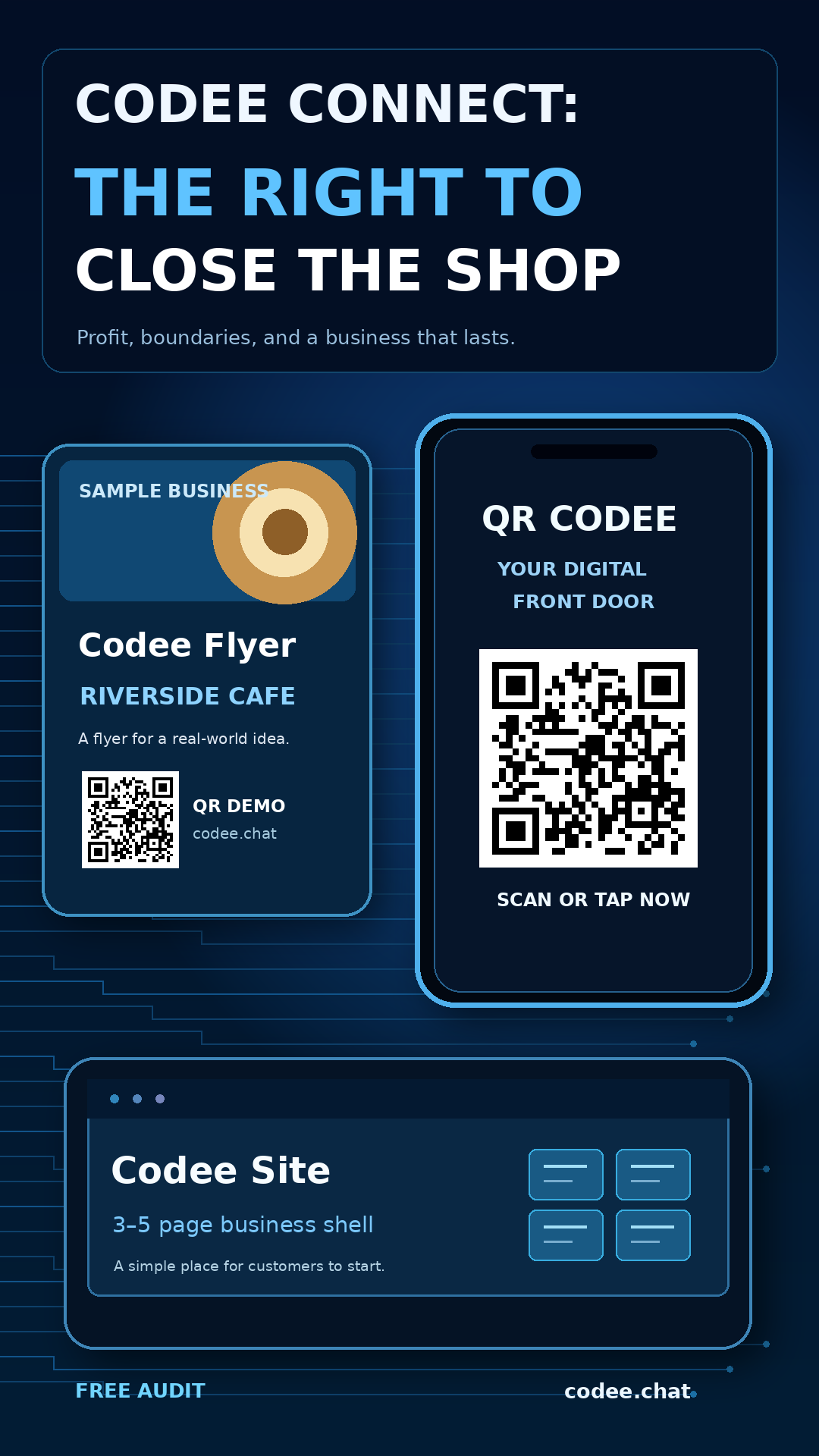
I want Codee's digital tools to feel understandable to people who are starting out and to established owners who already have too many moving pieces. QR Codee is the idea of a simple, phone-friendly introduction built around a prominent QR and a short prompt to scan or tap. Codee Flyer gives a business a visual promotional doorway with its own smaller corner QR. Codee Site is the three-to-five-page shell for explaining an offering more fully. The fourth option is a free audit that helps someone evaluate whether the current customer journey is confusing before paying for something larger. Exact features and availability should be confirmed for each client rather than inferred from a mockup.
Take a hypothetical neighborhood café that wants honest hours and clear expectations. A beautifully designed Codee Flyer might help people remember its name, but any actual QR destination must be checked before the business shares it. The Daily Bean sample flyer on today's approved cover is a fictional demonstration, not a client advertisement, and its printed QR-style mark has not been independently scan-tested. QR Codee provides the large phone-friendly scan-or-tap introduction; the flyer uses a separate small corner QR; and a Codee Site can explain services, hours and follow-up steps more completely. A thoughtful digital doorway does not require an owner to promise service at midnight.
Before any launch, I would ask an owner to write down operating hours, what counts as an urgent issue, a clear refund or correction policy, a real contact method and one measurable customer next step. Then the owner can decide whether the QR introduction, flyer, simple site or no new tool at all is appropriate. More software is not always the answer. Sometimes a better paragraph, a corrected link and a promise the business can keep are enough.
The Invest in Vets Mission: A Digital Doorway to Dignity
I also want Codee Connect to explain why this work matters beyond a sale. Invest in Vets is pursuing a free Veteran Site powered by Codee for eligible homeless disabled veterans. The idea is to give a consenting veteran a clear digital page or QR that can lead a supporter to the veteran's own chosen authorized donation method. This could offer another path to direct support beyond asking strangers for cash at the roadside. It is an intended service model, not a claim that every veteran is already enrolled or that any payment account has been activated.
The mission is not to take a cut of veterans' donations: Codee's intended platform share is zero. That is different from promising that a veteran receives exactly 100% of every gross payment, because payment-provider fees, chargebacks, payout limits or taxes can affect net amounts. We must protect voluntary consent and privacy, verify payment destinations, avoid publishing unsafe location details, and connect people with housing and benefits help as well as digital support. The VA's National Call Center for Homeless Veterans is available confidentially at 877-424-3838.
For me, closing the shop responsibly and building a direct-support site are connected ideas. Both are about respecting the actual person behind the transaction. A business should make enough to last without asking anyone to surrender their dignity. A technology mission should make it easier for the person with the least power to be seen and supported—without making guarantees it cannot deliver.
If your business needs a clearer customer doorway—or you want to understand the veteran-site mission—start with https://codee.chat/ and https://investinvets.online/.